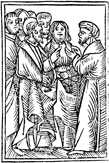
 In Mark 3:7-35, Jesus goes to a lake, a mountain, and an unidentified home. In all of these places, Jesus will be surrounded by people. At the lake crowds are pressing in so that Jesus must retreat to a boat before he is crushed. At the house, Mark tells us that the crowds were so thick and troublesome, Jesus and his disciples were unable to eat. In between, he takes a hike up a mountain.
After the Pharisees begin to plot with the Herodians over how they might end Jesus’ life, Mark has Jesus retreating with his disciples to the lake, the Sea of Galilee. Jesus tries to withdraw, but the people draw near. Mark is keen to tell us that all kinds of people, from “Judea, Jerusalem, Idumea, and the regions across the Jordan and around Tyre and Sidon”, came to see Jesus. Everyone wants to see this man for themselves. I tend to think about Jesus being surrounded by a nice orderly crowd, but, based on Jesus’ request for a boat, it seems this crowd was anything but serene. Those with diseases are pressing to be near him and those with unclean spirits see Jesus, they fall down in front of him and identify him as the Son of God. Jesus tells them to be quiet.
Jesus then goes to a mountainside, and Mark tells us that Jesus calls to him those he wanted, which I think contrasts nicely with the crowds gathering to see him. Jesus then appoints twelve to be those who are sent out to accomplish two things: 1) preach and 2) to drive out demons on the authority and based on the commission from Jesus. The location of a mountain always brings to my mind the giving of the Law to Moses, who ascends, receives the message from God, and brings it back to the people. Jesus does something different here. He calls those he is empowering to the mountain, sending them out to be heralds of God as king and the kingdom of heaven as the dominant socio-political force in the world.
In the third act of this section, Jesus goes into an unidentified house. This time the commotion was so great that Jesus and his disciples weren’t even able to sit and enjoy a meal together. Two accusations are leveled at Jesus. The first comes from his family, “He is out of his mind!”. The second comes from the teachers who had come down from Jerusalem to protest, ““He is possessed by Beelzebul! By the prince of demons he is driving out demons.” Jesus will deal first with the teachers of the law and then his family.
To the teachers of the law, Jesus makes it clear that a divided kingdom will never stand. If Jesus is possessed, how is he able to drive out demons from those who are possessed with a demon. Why would Satan allow such a thing to happen? You can’t rob a strong man’s house without first tying him up and them taking what he has. The lesson here is that Jesus has bound Satan and is able to rob him of those whom he has possessed.
Jesus takes his rhetoric one step further. Instead of simply refuting the teachers of the law and moving on, he offers a harsh judgement against them and their particular brand of self-righteousness. If the religious leaders are the ones saying Jesus has an impure spirit, they are failing to recognize the work of the Holy Spirit. This is the ‘eternal sin’ Jesus mentions. There’s endless speculation over this, but I think it’s the failure to recognize the work of God’s spirit – attributing the work of God to the work of Satan.
In verse 31, Jesus’ mother and brothers make an appearance so that he might deal with the accusation they brought against him, that he was out of his right mind. They ask to see Jesus by sending someone in to visit with him. I wonder why Jesus’ family didn’t go into see him themselves. Were there too many people? Did they not want to associate with the rowdy people who were clamoring to see Jesus? Were they afraid for their own safety? The spokesperson tells Jesus that his family is looking for him. I think this is an odd way of phrasing this because other people had been looking for Jesus and had obviously found him. Why wouldn’t his family enter the house and look for him themselves? Jesus rhetorically asks, “Who are my mother and brothers?” He answers it by claiming that those who draw near to him and do the God’s will is his brother and mother.
People, crowds of people, bookend these three scenes. There’s a mix of swarming crowds gathering around Jesus and his disciples who are sent to the swarming crowds. In a culture that was heavily organized by societal hierarchies and peppered with the importance of family, Jesus does something radical here when he appeals to the crowds. He accepts them (he doesn’t even know them) and claims that those who do his will are his closest relatives (which means he gives a back seat to his closest relatives).
Roman emperors knew the power of the populous masses and sought to control them with a variety of tactics. The Roman writer Juvenal passes along the policy of Emperor Augustus whereby the Plebians would be appeased with ‘bread and circuses’. In other words, you’ve got to give the people what they want, food and entertainment, or they’ll revolt against you. The gladiator battles and hippodrome races where a major aspect to this policy. Jesus isn’t simply appeasing the crowds. He’s meeting their needs at a deeper, more intimate level. This isn’t appeasement. It’s fulfillment.
For Mark, King Jesus has fully assumed control of his kingdom. He has brought good news and peace (1:1), had a royal servant prepare his path (1:2-4), received divine recognition as a Son of God (1:11), communicated his platform (1:15), gathered his inner council (1:16-20), battled against the warring powers (1:23-26), initiated his welfare policy (1:32-34), debated other religious-political leaders (Mark 2), trained his inner council to act on his behalf (3:13-19), received adulation from crowds (3:7-12), and settled the question about the inheritance of his crown (3:34-35).
 douglaskwilliams.com