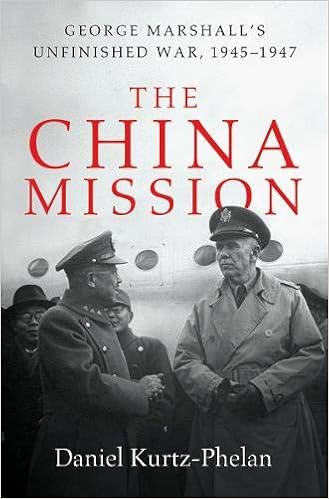
 General George Marshall was tasked with a gargantuan problem at close of World War II. After being instrumental in the Allied victories, and hoping to return to his retreat in Leesburg, VA for a much earned rest, Marshall instead chose to answer the call of President Truman to head up a negotiation mission to China.
Much like western Europe after World War II, China was in the throes of ideological debates, and sometimes outright fighting, between the Nationalists and Communist parties. With China being in close proximity to the Soviets, it was deemed crucial to America’s role in stabilizing the world, and promoting democracy, that negotiations would be carried out in China in order to reach a democratic, consensus government. This was to be Marshall’s task in China.
The China Mission details Marshall’s attempts at negotiations with both sides, even as fighting broke out in Manchuria and other regions, Marshall was heralded on both sides, as a fair and tough-nosed negotiator. However, Chiang knew that in a prolonged skirmish between the Nationalist and Communist forces the might of the U.S. military would be forced to align with his regime. Perhaps because of this, perhaps because of the inability of these Chinese factions to reach much agreement on anything related to a coalition government, Marshall failed to negotiate prolonged peace. China became swept up in a civil war with Mao and Communist forces ultimately declaring a People’s Republic of China on October 1, 1949.
What lessons on leadership are even possible from such an issue as this? Well, Marshall went on to develop one of the largest post-war economic aid propositions in the history of the United States. By sending plane loads and truck fulls of supplies to struggling economies and governments in Europe, Marshall put forth American policy on dealing with the Soviets during the Cold War.
However, much of Marshall’s work in China was seen as a failure. However hard Marshall tried to muster his powers of intellect, persuasion, and discipline on the situation in China, the problem was ultimately too complicated and the personalities he was dealing with were too idealistic and resistant to change.
At some point, failure will happen. The proposal will fail, the initiative will be replaced. The stock market will drop, the business will be sold. What amazes me the most about Marshall is his ability to rebound and exhibit a tremendous amount of grit to pivot from failure in China to Secretary of State and the execution of the Marshall Plan. No one wants to experience failure, but there are times and examples, where failure can be the impetus for something much greater.
 douglaskwilliams.com