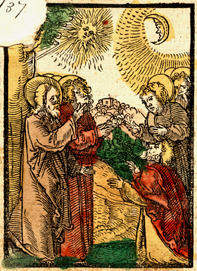
 In the same way that Mark 2:13-22 includes two questions, the first one asked about Jesus and the second one asked about Jesus’ disciples, this section, Mark 2:19-3:6, includes two questions. The first is directed towards Jesus about his disciples, and the second where Jesus asks a question no one is willing to answer.
In the first Sabbath scene, Jesus is asked about a practice in which his disciples are engaging: picking heads of grain from the fields. This practice of gleaning can be found in three passages from the Old Testament, Leviticus 19:9-10, Leviticus 23:22, and Deuteronomy 24:19-22. This practice is also described in the story of Ruth 2 as a kind of social welfare for Ruth and Naomi.
Of course, the Pharisees know these passages from Leviticus and they know about Ruth and Naomi. Their problem is not that the disciples are eating from the fields, but that they are eating from the fields on the Sabbath. So, when Jesus is asked about their practice, he doesn’t refer back to Leviticus, Deuteronomy, or Ruth, but he references a story from 1 Samuel 21 where David, on the run from Saul, stops and requests from the priest the consecrated bread for himself and his companions.
Perhaps what Jesus is implying here is that if David, while on his way to becoming king over Israel, makes an exception to the rule (Leviticus 22:10) when it comes to eating the consecrated bread, so to Jesus, who is a Son of David, the King of Kings, has the right to challenge restrictions on picking grain on the Sabbath. Perhaps the analogy is that in the same way David has some discretion in pursuit of his kingship, so too Jesus has discretion as he assumes his kingdom. After all, it is the king who makes and enforces the rules. In essence, what he says to the Pharisees is that they believe David had the right to make an amendment to ceremonial regulations, so why wouldn’t the Son of God have those same rights.
Mark then deftly connects this story of the disciples picking grains with their hands on the sabbath to man before Jesus on the sabbath with a withered hand – unable to pick grain or do much other work to support himself. To have a deformity like this would mean not only that the man is unable to work, but probably couldn’t even engage in the social welfare described above that was intended to protect him.
It’s into this second sabbath story that Jesus asks his question: “Which is lawful on the Sabbath: to do good or to do evil, to save life or to kill?” We’ve seen several questions flying around in the gospel of Mark so far, even several questions from Jesus. This is the first time, though, that Mark tells us that everyone remained silent as a response to Jesus’ question. Mark portrays Jesus’ emotion, his anger and astonishment at their indifference. The question is answered by Jesus asking the man to stretch out his restored hand. From here the Pharisees partner with the Herodians, a reference to those who would count themselves as supporters of Herod Antipas, to plot how they might destroy this usurper to the throne.
I think what Mark is setting up for us in these passages is the battle between the kingship and Kingdom of God against the kingship and kingdom of the Pharisees and the Herodians. Jesus, quite naturally, comes into conflict with the kingdoms of the Pharisees and the Herodians. Mark’s inclusion of Jesus’ reference to King David as he was assuming the throne should place into our minds notions of Jesus as King and assuming a very different kind of throne. For the reader, the differences between these kingdoms are beginning to come into focus.
 It’s now Jesus’ turn to be asked a question. In 2:16 it’s the pharisees question Jesus’ disciples about why he’s eating with tax collectors and sinners. In 2:18 they, potentially generic people, ask Jesus why his disciples fail to fast. When compared with the previous questioning, it appears that Mark is having a bit of fun with us as the disciples are questioned about Jesus’ actions and Jesus is questioned about the disciples’ action. In fact, if you go back to the healing of the paralyzed man in 2:1-12, there are questions floating about, directed at no one in particular, that Jesus answers. So, there is a movement from 1) questions directed at no one, 2) a question directed at Jesus’ disciples, and then 3) a question directed at Jesus. Jesus tries to clear the air by pointing out that the guest of honor is in town and you wouldn’t hold a fast when you were supposed to have a feast. The time for fasting will come, but the time now is to feast. Jesus even answers their question with a question, “The wedding guests cannot fast while the bridge groom is with them, can they?”
 I’m currently reading a book on Ignatian spirituality written by a Jesuit, Father James Martin. The title is a little embarrassing so I won’t type it out. It’s a good introduction to Jesuit spirituality and the rule of life established by Ignatius.
 I read BBT’s Leaving Church in three nights. Her descriptions of faith and people and the ins and outs of ministry play with your mind and imagination. She has the ability to create a longing for another life as well as help you feel that that the life you have is so grand that it’s more than you could ever have asked for. My copy of the book came from the local public library, and I found myself dog-earring pages of the book, something I refrain from doing to even my own books much less one that belongs to the public. I noticed that previous readers had done the same, and I found myself turning down the corners of pages that had already been folded once before, smoothed back leaving a faint crease. Soon I began to look for these invisible lines. When I found one, I would search the page trying to discover what caught another’s mind. Here are some of my, and Nashville’s, favorite sections.
 Reading Rob Bell is like listening to pop music. It’s catchy, fun, and, when you turn it off, you walk around humming it just above a whisper. I’ve read a few of Bell’s books (Velvet Elvis, Sex God, Jesus Wants to Save Christians, Drops Like Stars), and I always get this feeling inside that I have to finish it as quickly as possible. Like it’s a race. I scan from one sentence to the next. You can’t linger over Bell. I don’t really know what this means; it’s just the way I read Bell.
 douglaskwilliams.com