Leading through Failure: Marshall and Unifying China

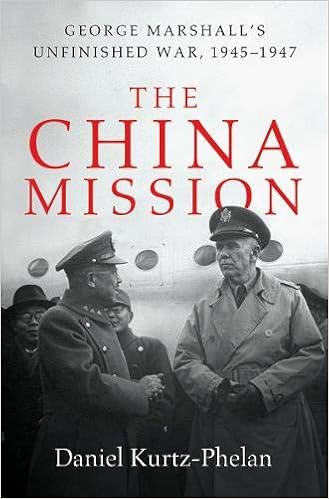
General George Marshall was tasked with a gargantuan problem at close of World War II. After being instrumental in the Allied victories, and hoping to return to his retreat in Leesburg, VA for a much earned rest, Marshall instead chose to answer the call of President Truman to head up a negotiation mission to China.

Much like western Europe after World War II, China was in the throes of ideological debates, and sometimes outright fighting, between the Nationalists and Communist parties. With China being in close proximity to the Soviets, it was deemed crucial to America’s role in stabilizing the world, and promoting democracy, that negotiations would be carried out in China in order to reach a democratic, consensus government. This was to be Marshall’s task in China.

The China Mission details Marshall’s attempts at negotiations with both sides, even as fighting broke out in Manchuria and other regions, Marshall was heralded on both sides, as a fair and tough-nosed negotiator. However, Chiang knew that in a prolonged skirmish between the Nationalist and Communist forces the might of the U.S. military would be forced to align with his regime. Perhaps because of this, perhaps because of the inability of these Chinese factions to reach much agreement on anything related to a coalition government, Marshall failed to negotiate prolonged peace. China became swept up in a civil war with Mao and Communist forces ultimately declaring a People’s Republic of China on October 1, 1949.

What lessons on leadership are even possible from such an issue as this? Well, Marshall went on to develop one of the largest post-war economic aid propositions in the history of the United States. By sending plane loads and truck fulls of supplies to struggling economies and governments in Europe, Marshall put forth American policy on dealing with the Soviets during the Cold War.

However, much of Marshall’s work in China was seen as a failure. However hard Marshall tried to muster his powers of intellect, persuasion, and discipline on the situation in China, the problem was ultimately too complicated and the personalities he was dealing with were too idealistic and resistant to change.

At some point, failure will happen. The proposal will fail, the initiative will be replaced. The stock market will drop, the business will be sold. What amazes me the most about Marshall is his ability to rebound and exhibit a tremendous amount of grit to pivot from failure in China to Secretary of State and the execution of the Marshall Plan. No one wants to experience failure, but there are times and examples, where failure can be the impetus for something much greater.


The Power of Moments

img-book-power-of-momentsWho doesn’t like a moment? Those unforgettable experiences that stay with you weeks and weeks after an event. It’s what memories are mad of, and it’s what most of us use to judge the significance of an experience.

Unfortunately, most of us tend to go through life waiting for moments to occur organically.

We’re usually wired to believe that moments can’t be created. As the faulty logic can sometimes go, who would want a contrived experience? Perhaps the question might be yes if that experience was filled with meaning and significance.

Well, the Heath brothers have done it again by showing us that perhaps one of aspects to your business, community, school, and/or religious organization is a lack of moments. An inattention to the times and opportunities you have to create lasting, meaningful moments for those in your purview. Times of transition, milestones that represent achievement or proficiency, and even pits that can best be described as traumatic are opportunities to think in moments.

Four elements are described in the book as opportunities to create moments: Elevation, Insight, Pride, and Connection.

Elevation. These are times in life that rise above the quotidian. Whether it’s a birthday, wedding, or retirement party, these are moments that already have a peak built into them. What the Heath brothers suggest is to take that peak and make it ‘peakier’.

How might you do this? The first idea is to “boost sensory appeal. This means making things look, sound, and taste better. The second is to raise the stakes. To do this, the Heath brothers suggest adding an element of “productive pressure”. Turning a moment into an event, a performance, or a game, elevates it to another level and increases expectation and buy in. The third idea to to “break the script”, which means that you introduce an experience that goes against common perceptions for how that experience should occur.

Insight. A moment of insight offers a new realization or a transformation. Noticing an aspect of a company, or noticing a part of an experience that you’ve missed before, can help to create insight.

Pride. Moments are elevated when we recognize the contribution, skills, and gifts of others. Scaling accomplishments and setting milestones that are well-defined and increasingly difficult help us to create better moments in our lives. Moments are also created when we have the courage to speak up and share our convictions with others.

Connection. When a group reaches a conclusion of shared meaning, new insight is reached and deeper relationships are formed.

Complacency has killed many institutions. Pursuing vibrant, thoughtful, energetic, and dynamic participation in a community leads to a deeper pursuit of mission and a deeper awareness of the possibilities that exist to make an impact where you want to make an impact.

Martin Luther as Leader

With 2017 being the 500th anniversary of the Reformation, I felt somewhat compelled to read Eric Metaxas’ biography on Martin Luther. Metaxas dispels a number of biographical rumors and inaccuracies related to Luther’s life, but I found a section on Luther’s leadership as the Reformation was beginning to sweep through the German states especially poignant and relevant to our own world.

A bit of context before I share a quote from Metaxas.

Pope Leo X and the emperor Charles V colluded to bring Luther, the rabble-rousing monk, before an official gathering of church and state officials to decide his fate. In a very real way, Luther’s life was on the line at the Diet of Worms where he famously made the proclamation, “Here I stand. I can do no other.”  In order to save Luther’s life, Frederick the wise crafted a plan to have Luther kidnapped and kept safe in a castle tower in Wartburg. It will be here that Luther begins to translate the New Testament to German, and it is also while Luther is here that others begin to take his ideas and run with them, often in ways that run contrary to Luther’s sensibilities.

One Reformation leader in particular, Andreas Karlstadt, begins to force practices on communities as it relates to Communion. It was a common practice for the priest to take both elements, the bread and wine, but for congregants to only take the communion wafer. In Luther’s absence, Karlstadt began to decree that true members of the church would take both Communion elements, inflaming believers throughout many German cities.

When news of this finally reached Luther in the Warburg castle, he was dismayed to hear how forceful and impractical Karlstadt was being with the implementation of Communion. All of this deeply troubles Luther who believes the Reformation is being taken over by sloppy thinking and forceful practices. Luther appeals to Christian freedom, noting that there will be some who choose to take both elements and others who choose to abstain from the wine. For Luther, a person’s conscience is not easily dismissed.

Reflecting on this time in Luther’s life, Metaxas writes these words about Luther as a leader:

Luther’s genious and what made him the unquestioned leaders of his movement comprised two things. First, he had the all-important pastor’s hear, such that he was deeply concerned not merely with being right but with how what one said affected the simple faithful. Luther knew that some had felt pushed too quickly and too hard by the changes that Karlstadt…had championed…One must be concerned for those who are not yet fully on board and must bring them along patiently. So to be right required being right not just in what one did and said but in the way one did and said things.

It’s clear that there’s something for leaders to consider when it comes to being right, not just in what you say or believe, but right in how you say and do.